

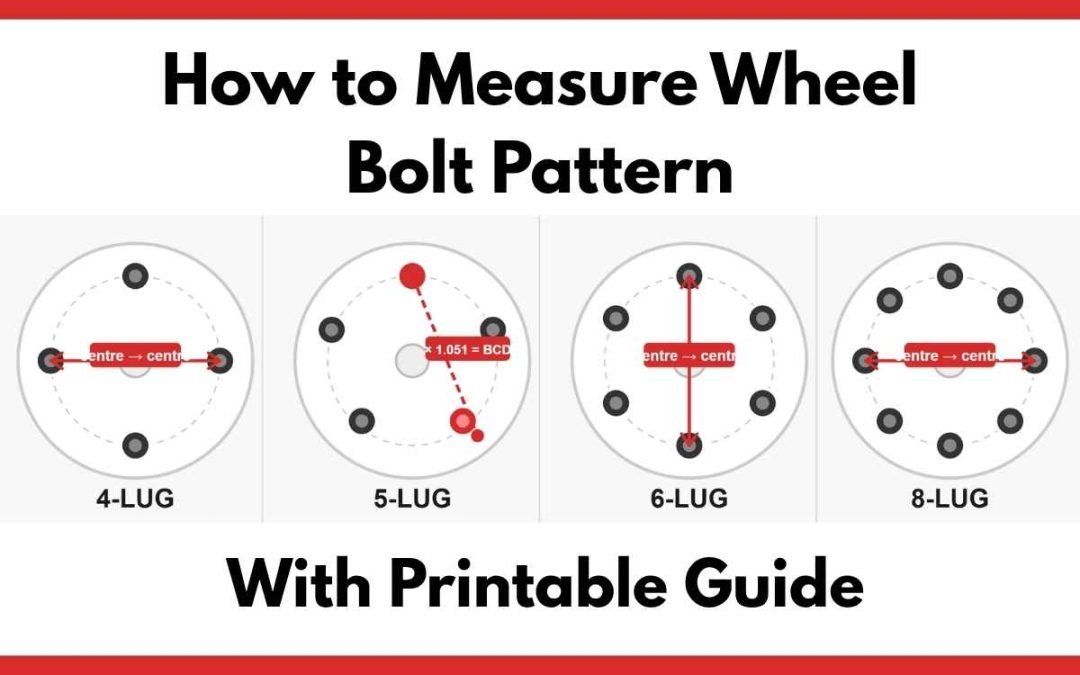
Getting new wheels for your vehicle sounds straightforward until you hit the bolt pattern question. The wrong bolt pattern means the wheels simply won’t fit — no matter how good they look. This guide walks you through exactly how to measure your wheel bolt pattern at home, what the numbers mean, and how to make sure your next set of wheels from Good Tire fits perfectly first time.
What Is a Wheel Bolt Pattern and Why Does It Matter?
A bolt pattern — also called a lug pattern or PCD (Pitch Circle Diameter) — describes two things:
- The number of lug holes on the wheel
- The diameter of the imaginary circle that runs through the centre of all those holes
It’s written as two numbers separated by an “x” — for example 5×114.3. The first number (5) is the number of lugs. The second number (114.3) is the diameter of the bolt circle in millimetres.
If your replacement wheel has a different bolt pattern than your vehicle’s hub — even by a few millimetres — it won’t mount safely. This is why measuring correctly before you buy matters.
How Do I Find Out My Wheel Bolt Pattern?
You have three options — from fastest to most hands-on:
Option 1 — Check your owner’s manual
Most vehicle owner’s manuals list the OEM wheel specifications including bolt pattern. Check the wheels and tires section.
Option 2 — Look up your vehicle online
Search “[Year] [Make] [Model] bolt pattern” — most automotive databases list this instantly. You can also bring your vehicle into Good Tire and we’ll look it up by make, model, and year in minutes.
Option 3 — Measure it yourself
The most reliable method when you’re fitting aftermarket wheels or working with an older vehicle where specs aren’t clear. Full instructions below.
How Do I Know My Bolt Pattern Size?
Your bolt pattern size is determined by two measurements — lug count and bolt circle diameter. Here’s how to identify both:
Step 1 — Count your lug holes
Look at your current wheel and count the number of lug holes. Common counts are:
- 4 lug — smaller economy cars (Honda Civic pre-2012, older Mazda)
- 5 lug — most passenger cars, crossovers, and light trucks
- 6 lug — larger trucks and SUVs (Silverado, F-150 with certain trims)
- 8 lug — heavy-duty trucks (Ram 2500, F-250 and up)
Step 2 — Measure the bolt circle diameter
This is where most people get confused — and the method differs depending on whether you have an even or odd number of lugs. Full measurement instructions in the next section.
How to Properly Measure Wheel Bolt Pattern?
You’ll need a ruler or tape measure in millimetres. The measurement technique depends on your lug count:
Measuring a 4-Lug Bolt Pattern
4-lug patterns are the easiest — measure directly from the centre of one lug hole to the centre of the lug hole directly opposite it. That measurement is your bolt circle diameter.
Example: Centre to centre = 100mm → Bolt pattern = 4×100
Measuring a 5-Lug Bolt Pattern
5-lug patterns can’t be measured directly across because no two holes sit exactly opposite each other. Use this method instead:
Method 1 — Centre to far edge:
Measure from the centre of one lug hole to the outer edge of the lug hole that is two holes away (skipping one hole). Multiply that measurement by 1.051.
Method 2 — Direct measurement:
Measure from the centre of one lug hole to the centre of the lug hole directly across — this won’t be perfectly opposite, but on a 5-lug wheel this measurement × 1.051 gives you the PCD.
Example: Measurement = 108.6mm × 1.051 = 114.1mm → rounds to 5×114.3
Measuring a 6-Lug Bolt Pattern
Same as 4-lug — measure directly from the centre of one lug hole to the centre of the lug hole directly opposite. These sit exactly across from each other on a 6-lug wheel.
Example: Centre to centre = 139.7mm → Bolt pattern = 6×139.7
Measuring an 8-Lug Bolt Pattern
Same as 4 and 6-lug — measure directly centre to centre across opposite holes.
Example: Centre to centre = 165.1mm → Bolt pattern = 8×165.1
How to Convert Lug Pattern Measurements?
Some bolt patterns are listed in inches in older American specs and millimetres in modern/metric specs. Here’s how to convert:
Inches to millimetres: multiply by 25.4
Millimetres to inches: divide by 25.4
Common conversions:
| Inches | Millimetres | Common Vehicles |
|---|---|---|
| 5×4.5″ | 5×114.3mm | Toyota, Honda, Nissan, Ford Mustang |
| 5×5″ | 5x127mm | Jeep Wrangler, older GM trucks |
| 5×5.5″ | 5×139.7mm | Dodge Ram 1500, older Chevy/GMC |
| 6×5.5″ | 6×139.7mm | Silverado, Sierra, Tundra, 4Runner |
| 4×4″ | 4×101.6mm | Older compact cars |
| 4×4.5″ | 4×114.3mm | Older Nissan, Mitsubishi |
What Is the Most Common 5-Lug Pattern?
The most common 5-lug bolt patterns are:
5×114.3 (5×4.5″) — the single most common bolt pattern in North America. Used by:
- Toyota Camry, Corolla, RAV4, Highlander
- Honda Accord, CR-V, Pilot
- Nissan Altima, Rogue, Murano
- Ford Mustang, Edge, Explorer
- Hyundai Sonata, Tucson, Santa Fe
- Kia Stinger, Sorento, Sportage
- Mazda CX-5, Mazda 6
- Subaru Outback, Forester, Legacy
5×120 (5×4.72″) — second most common, used by:
- BMW 3, 5, 7 Series
- Chevrolet Camaro, Malibu
- Cadillac CT5, Escalade (some trims)
- Honda Odyssey
5×127 (5×5″) — common on American SUVs and trucks:
- Jeep Wrangler, Cherokee, Grand Cherokee
- Chevrolet Traverse, Equinox (some trims)
- GMC Acadia
Printable Bolt Pattern Reference Chart
Save or print this chart before shopping for wheels:
| Bolt Pattern | Common Vehicles |
|---|---|
| 4×100 | Honda Civic (pre-2012), VW Golf (older), Toyota Yaris |
| 4×114.3 | Older Nissan, Mitsubishi Eclipse |
| 5×100 | Subaru Impreza/WRX (pre-2012), VW Golf/Jetta (older) |
| 5×10⁸ | Ford Focus/Fusion, Volvo, Land Rover (older) |
| 5×112 | Audi, Volkswagen (current), Mercedes-Benz (some) |
| 5×114.3 | Toyota, Honda, Nissan, Ford Mustang, Hyundai, Kia, Mazda |
| 5×120 | BMW, Chevrolet Camaro, some GM |
| 5×127 | Jeep, some Chevrolet/GMC SUVs |
| 5×130 | Porsche |
| 5×139.7 | Dodge Ram 1500, older Chevy/GMC trucks, Mitsubishi Pajero |
| 6×114.3 | Nissan Frontier, Pathfinder, Titan (some) |
| 6×135 | Ford F-150 (2004+), Expedition |
| 6×139.7 | Toyota Tundra, 4Runner, Tacoma, Chevy Silverado 1500, GMC Sierra |
| 8×165.1 | Ram 2500/3500, Ford F-250/F-350 |
| 8×170 | Ford F-250/F-350 (2000–2004) |
| 8×180 | Chevy Silverado 2500/3500, GMC Sierra 2500/3500 |
Not Sure About Your Bolt Pattern? We’ll Check For You.
Bring your vehicle into Good Tire in Calgary and our technicians will identify your bolt pattern instantly using our fitment database. We’ll match you to wheels that fit perfectly — no measuring, no guesswork, no returns.
Browse our full selection of wheels and rims in Calgary or come in any day of the week.

FAQ — Wheel Bolt Pattern
Is 5×4.5 and 5×114.3 the same bolt pattern?
Yes — exactly the same. 5×4.5 is the imperial measurement in inches, and 5×114.3 is the metric equivalent in millimetres. 4.5 inches × 25.4 = 114.3mm. You’ll see both used interchangeably depending on the source — American spec sheets often use inches, while modern fitment databases use millimetres. They refer to the exact same bolt circle diameter.
Is 5×5 and 5×5.5 the same bolt pattern?
No — these are two different bolt patterns and they are not interchangeable. 5×5 equals 5x127mm and is common on Jeep Wrangler and older GM trucks. 5×5.5 equals 5×139.7mm and is common on Dodge Ram 1500 and older Chevrolet/GMC trucks. Mounting a 5×127 wheel on a 5×139.7 hub — or vice versa — is unsafe and the wheel will not seat correctly.
How do you measure a 5-lug bolt pattern?
Measure from the centre of one lug hole to the outer edge of the lug hole two positions away — skipping one hole. Multiply that measurement in millimetres by 1.051 to get your bolt circle diameter. For example, if that measurement is 108.6mm, your bolt pattern is 5×114.3. Always measure in millimetres for accuracy.
Are all 5-lug patterns the same?
No — there are multiple different 5-lug bolt patterns and they are not interchangeable. The most common include 5×100, 5×10⁸, 5×112, 5×114.3, 5×120, 5×127, and 5×139.7. Each has a different bolt circle diameter and requires a wheel drilled to match that exact specification. Always verify your specific bolt pattern before purchasing wheels.
How do you measure a 5×114.3 bolt pattern?
Measure from the centre of one lug hole to the outer edge of the lug hole two positions away. That measurement should come out to approximately 108.6mm. Multiply by 1.051 and you get 114.1mm — which rounds to 114.3mm, confirming a 5×114.3 pattern. You can also measure centre-to-centre between two adjacent holes and compare against a known reference chart.
Is there a difference between 5×5 and 5×5.5 bolt pattern?
Yes — a significant one. 5×5 (5x127mm) and 5×5.5 (5×139.7mm) differ by 12.7mm in bolt circle diameter. That gap means the lug holes won’t line up between the two patterns — a wheel drilled for one will not safely mount on a hub designed for the other. Never attempt to force-fit mismatched bolt patterns. Always confirm your exact specification before ordering wheels.